In my former role as General Manager of Operations at a small utility, our water distribution crews regularly reminded me that they needed the same level of investment provided to the treatment plant. Additional staffing and a more proactive approach to system maintenance came up in nearly every team meeting.
Their concern reflected a challenge shared by many utilities: water distribution assets are often among the system’s most underfunded infrastructure.
Visibility plays a major role. Treatment plants are highly regulated, their performance is measurable, and their condition is relatively visible. Reservoirs and pumping stations can be evaluated through visual inspections and performance-based condition assessments.
Pressurized, buried water mains are different. From a customer’s perspective, water service can appear binary: turn on the faucet, and water either comes out or it does not. The deteriorating infrastructure beneath the street remains largely invisible – until it fails.
Managing risk without seeing the asset
How should utility managers address risks associated with infrastructure they cannot easily inspect?
Because direct assessment of buried, pressurized systems can be difficult and expensive, many utilities plan replacements using remaining-useful-life assumptions based primarily on pipe age and material. Others use statistical models to estimate which pipes are more likely to fail.
These methods can support planning, but age and material alone do not tell the full story. Two pipes installed in the same year and made from the same material may perform very differently because of soil conditions, pressure, installation quality, operating environment, previous failures, and the behavior of nearby assets.
In practice, many replacement needs are still “identified” by emergencies. A main breaks, customers lose service, roads are damaged, crews work overtime, and the utility must fund an unplanned repair. This reactive cycle is expensive, disruptive, and contrary to a central objective of good utility management: directing limited resources proactively toward the risks that matter most.
Moving from reactive to risk-based decisions
Advances in artificial intelligence and machine learning give utilities a practical way to manage buried-infrastructure risk more proactively. AI models can evaluate complex combinations of information that are difficult to analyze manually, for example:
- Pipe age, material, and diameter
- Break and repair history
- Soil and environmental conditions
- Pressure and operating characteristics
- Installation period
- Nearby asset performance
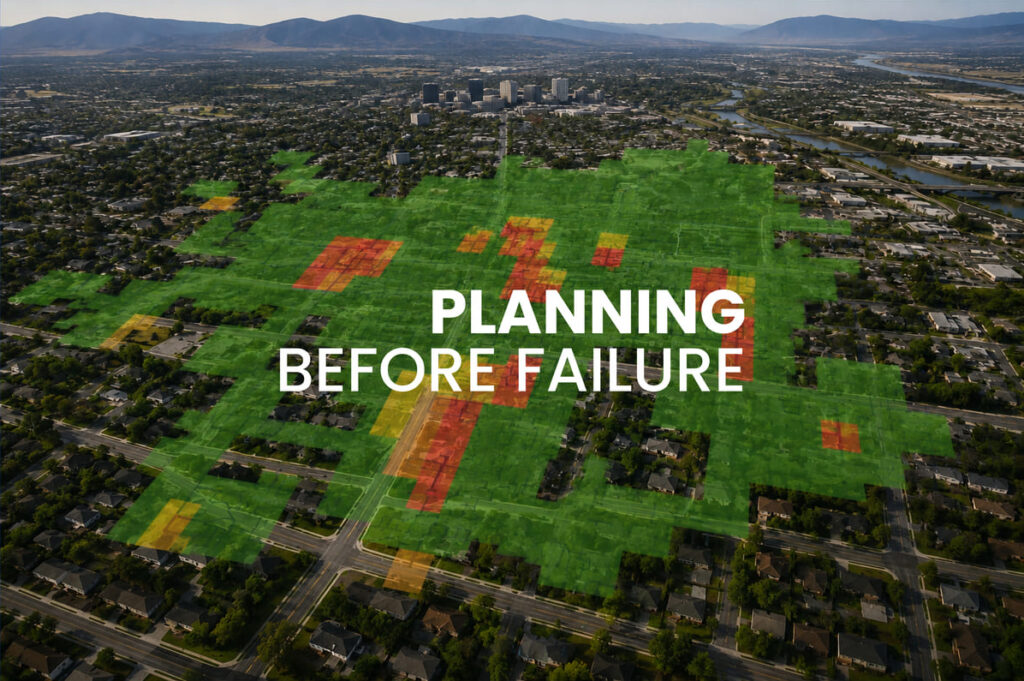
The goal is not to predict the exact date and location of every water-main break. No model can do that with certainty. Instead, AI can identify patterns across a distribution system and rank assets by their relative likelihood of failure.
But likelihood of failure is only half of the decision. A pipe with a high likelihood of failure may create relatively limited exposure if it serves few customers, is easy to isolate, and can be repaired without significant disruption. Conversely, a pipe with only a moderate likelihood of failure may create substantial exposure if it serves a hospital, crosses a major roadway, provides critical fire flow, or has no practical redundancy. Utilities must therefore evaluate both likelihood of failure and consequence of failure. Consequences may include:
- Number and type of customers affected
- Service to hospitals and other critical facilities
- Emergency repair costs
- Traffic and community disruption
- Environmental damage
- Water loss
- Availability of system redundancy
- Effects on public confidence
Combining likelihood and consequence produces a Business Risk Exposure, or BRE, score for each asset. That changes the question from “Which pipe is most likely to break?” to a much more valuable one: Which potential failure creates the greatest risk exposure for our utility and community?
Business Risk Exposure (BRE) is not the finish line
Business Risk Exposure helps a utility understand and prioritize risk, but good utility management is not simply about driving risk as low as possible. It is also not about selecting the lowest-cost plan.
A strategy focused primarily on minimizing near-term costs can leave the community with unacceptable service interruptions, water loss, emergency expenses, and exposure to high-consequence failures. At the other extreme, replacing every aging or potentially vulnerable asset would be financially unrealistic and could impose unnecessary costs on ratepayers. The manager’s responsibility is to balance three connected considerations:
- Business Risk Exposure
- Lifecycle cost
- The level of service expected by the community and organization
That balance is where community values become part of asset-management decisions.
One community may place a high priority on affordability. Another may emphasize resilience, uninterrupted service to major employers, fire protection, environmental stewardship, or accelerated water-loss reduction. Most communities value all of these outcomes, but their priorities and willingness to invest will differ. There is no universal “correct” level of infrastructure risk. The appropriate balance depends on what a utility and its community are trying to achieve.
Building a defensible investment case
A risk-based approach gives utility managers a clearer and more defensible way to communicate infrastructure needs to finance teams, governing boards, and ratepayers.
Rather than presenting a list of old pipes, managers can show how different investment choices affect organizational risk, customer service, and rates.
For example, a utility might compare:
- Replacing its ten highest-BRE water mains to mitigate community risk in key areas
- Replacing more miles of lower-risk pipe to increase the amount of pipe replaced
- Conducting targeted condition assessments to make repairs on a limited budget
- Improving isolation or redundancy to lower hydrologic risk
- Adjusting pressure-management practices to support economic development initiatives
- Deferring projects while monitoring changes in risk to save for higher priority projects
These scenarios can reveal which combination of interventions produces the greatest benefit for the available funding. Replacement will sometimes be the best response, but not always. Operational changes, condition assessment, pressure management, or improved redundancy may reduce exposure to risk more cost-effectively.
This creates a direct connection between infrastructure spending and outcomes that customers and decision-makers understand:
- Fewer emergency repairs and service interruptions
- Reduced water loss
- Better protection for critical customers
- More predictable capital and operating costs
- Greater system resilience
- Transparent management of organizational risk
AI-supported risk analysis can strengthen a utility decision making process by documenting why one project should advance ahead of another. That transparency is especially valuable when funding is limited, and buried infrastructure projects are competing for attention.
Using better information to serve community priorities
Utility managers are stewards of both essential infrastructure and public resources. Their job is not to eliminate every risk or pursue the lowest possible cost. It is to make informed tradeoffs that deliver an appropriate level of service at a cost the community can support.
AI gives utilities a stronger foundation for those decisions. By analyzing far more information than traditional age-and-material approaches, it can improve likelihood-of-failure estimates and help utilities understand where their most significant exposures lie.
Business Risk Exposure then translates that technical insight into a management framework – one that connects asset conditions, failure consequences, investment requirements, and community priorities.
The result is more than a better replacement list. It is a more transparent and defensible way to invest, balancing risk and cost while delivering levels of service aligned with the values of the utility and the community it serves.
This article is part of our Utility Voices series – where we share real stories, field-tested insights, and trusted perspectives from across the water sector. From frontline engineers to leading consultants, from early questions to proven outcomes, these are the voices shaping the future of water.
🔔 Subscribe to our blog to hear what’s working – and what’s next.