
CAPITAL PLANNING
You’ve ranked your pipes by business risk. Now turn that intelligence into defensible capital projects-faster, smarter, with measurable ROI at every budget level.
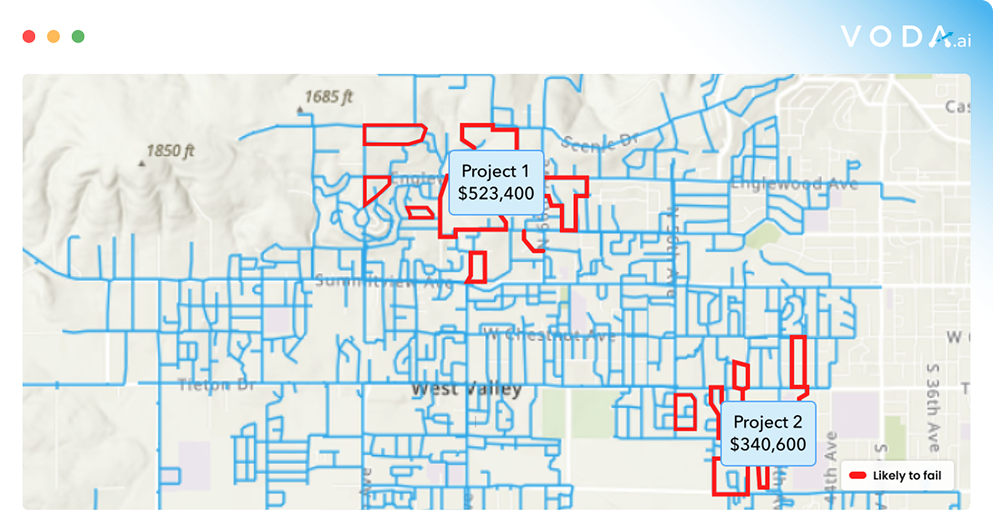
Turn your highest-risk pipes into ranked, ready-to-execute projects, built to your budget and goals.
Know where leaks are most likely before your crews go out searching. Planner identifies high-risk segments, so your leak detection surveys focus on the pipes that count.
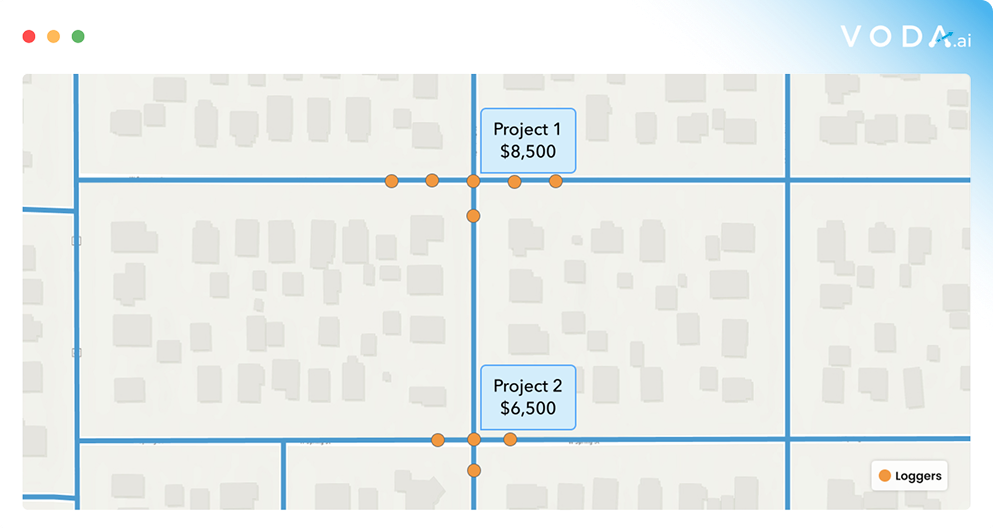
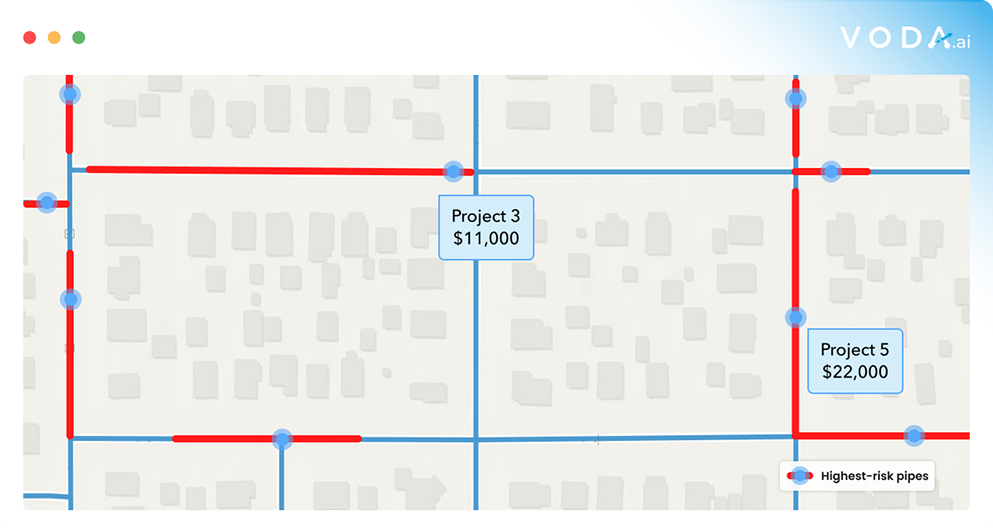
Know which pipes justify the cost of a condition assessment survey. Planner identifies your highest-risk segments, so you spend assessment dollars where they matter most.
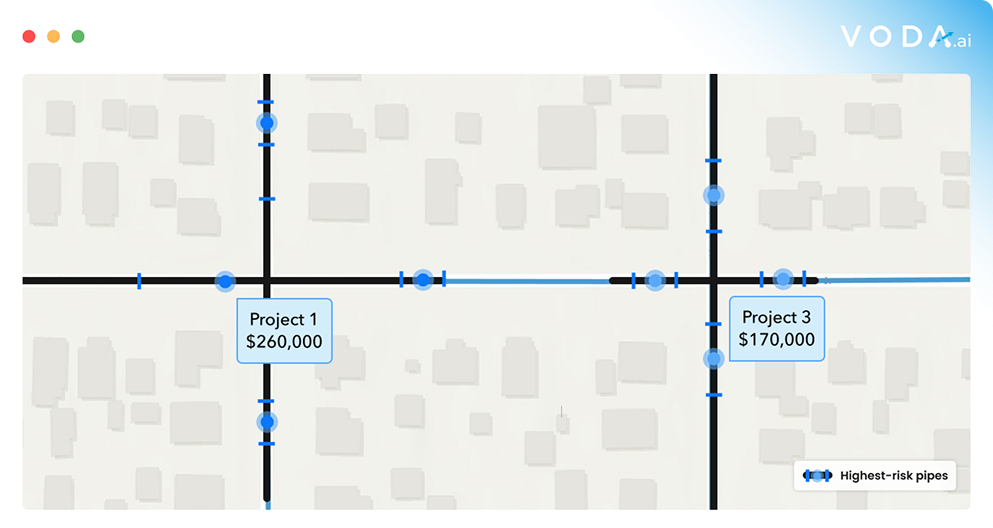
When rehab’s the play, Planner turns your highest-risk pipes into a fundable project – built to your goals, budget, and timeframe.
HOW IT WORKS
Step 1
Failure risk, pipe material, age, break history. Your data decides what drives renewal and replacement. No black box. Your system, your rules.
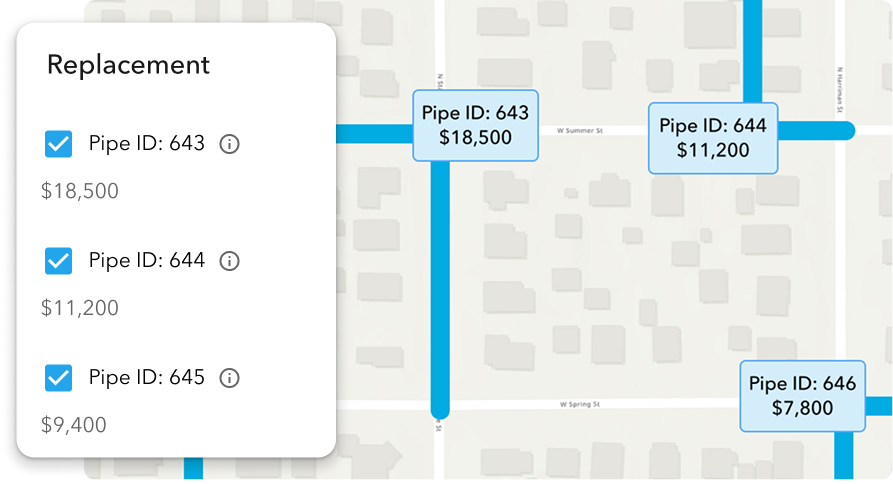
Step 2
Plan by budget or by goal. Then set your constraints: budget cap, crew availability, project turnaround time, cost per foot. Planner respects them from the start.
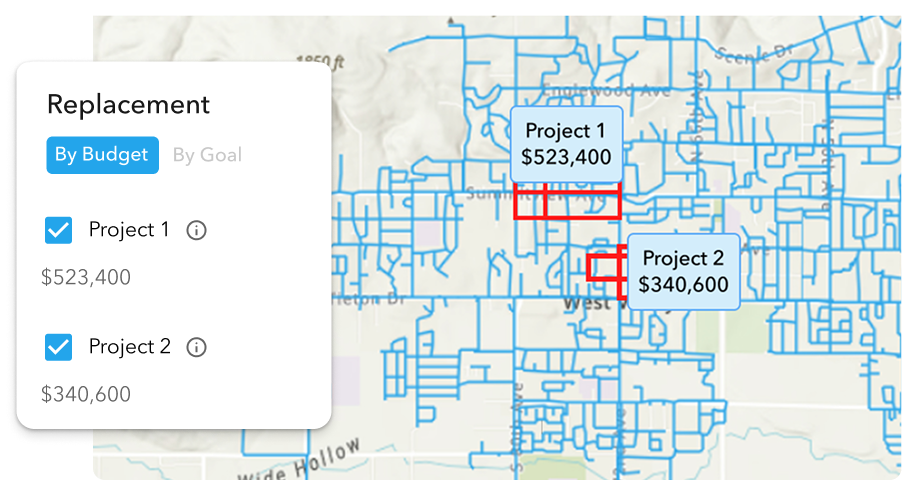
Step 3
Projects ranked by what matters to you. See them mapped. Compare them side by side.
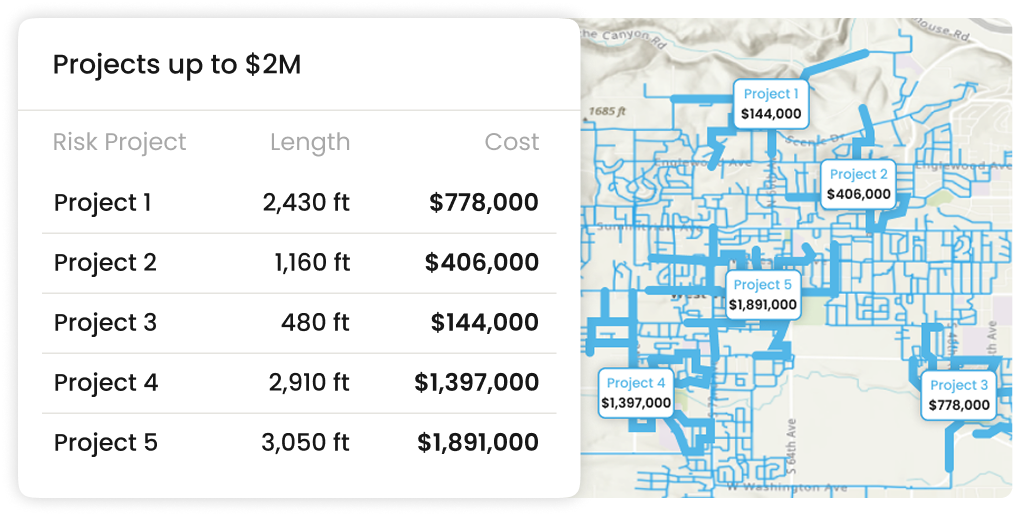
Step 4
Pick the project that works for you. Open it to see which mains it includes. Adjust timing and scope, export to GIS, and hand off to your operations team.
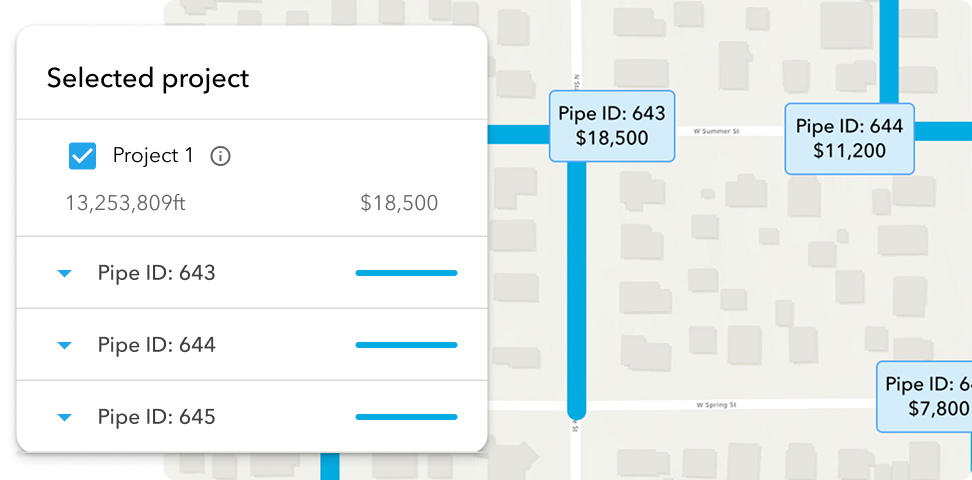
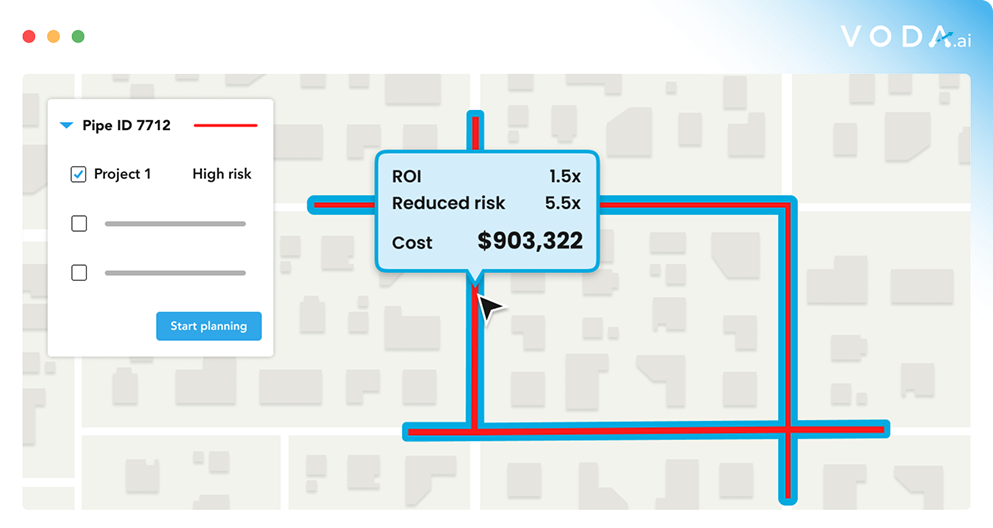
PIPE-TO-PROJECT
Pick a high-risk pipe. Planner generates three to five complete replacement projects at different budget levels. Each one includes nearby segments that belong together. Connected scopes your crews can execute. Not a scattered list.
MULTI-YEAR CAPITAL PLANNING
Planner builds capital programs on any horizon, whether it’s next year’s budget, a 3 to 5 year cycle, or a 20-year plan. Phase projects across budget cycles, smooth your spending instead of absorbing a spike, and bring your board and your rate case a long-range program you can stand behind.
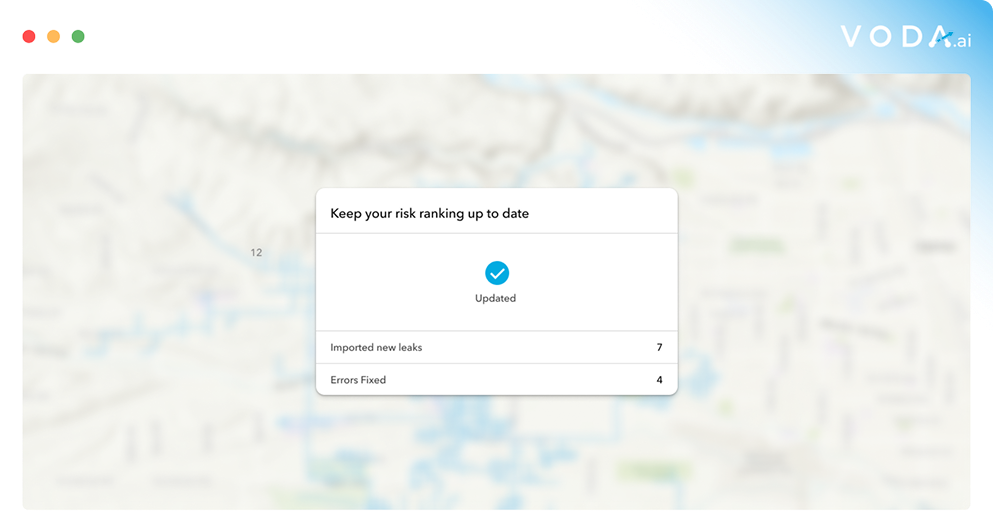
ALWAYS-CURRENT RANKINGS
Your crews log new main breaks and leaks every week. Risk Refresh lets you upload your latest records and update your risk rankings, so the priorities feeding your capital plan reflect what’s in the ground today. Plan from current risk, not last year’s.
“VODA.ai helped us target the right neighborhoods and pipes for assessment and replacement. The accuracy saves us time and money.”
Scott Schladweiler
Chief Engineer
Tucson Water

WHY IT MATTERS
Scenarios that took weeks to months now take minutes. When risk changes, regenerate instantly.
"Why this scope?" gets answered with data. Risk reduction percentage, ROI, mapped segments. Your board sees the math.
See what each budget level buys you. Test different approaches. Turn risk insight into the right project, not just a list of risky pipes.
Engineering, operations, and finance use the same numbers. One source of truth. Shared logic across teams.
RESOURCES

Case Study
Plano is facing a growing challenge: over 110 miles of large-diameter water mains…

Blog
Water meters are the financial backbone of any water utility. They track every gallon delivered, determine how much customers are…
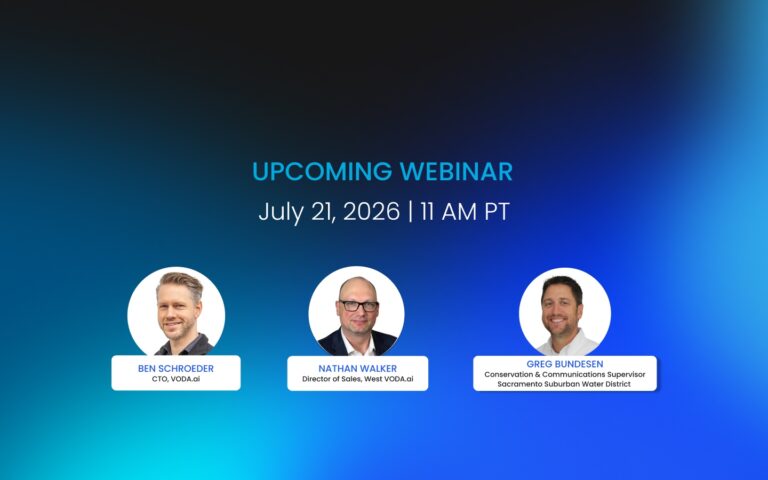
Webinar
Featuring Sacramento Suburban Water District on using targeted leak detection to find what rotational…

Event
Join the VODA.ai team at the Smart Water Summit 2026 in Denver, Colorado – a unique gathering that brings together North American water utility professionals and industry leaders for…
FAQ
Planner is a capital planning solution that helps water utilities make data-driven decisions about which pipes to replace, assess, or monitor. Instead of relying on spreadsheets, historical breaks, or consultant reports, utilities use risk modeling to prioritize pipes by likelihood of failure and consequence of failure. VODA.ai’s Planner specifically helps utilities move from identifying risk to building funded replacement projects. Rather than just knowing a pipe is high-risk, utilities can generate multiple project scenarios at different budget levels and see the tradeoff between spend and risk reduction. This transforms capital planning from a reactive, manual process into an agile, defensible one that boards and finance teams can approve with confidence.
Traditional capital planning requires utilities to spend two to three weeks building scenarios manually in spreadsheets. Engineers gather pipe data, estimate costs, model different combinations, and present to leadership for approval. When budgets change or conditions shift, the entire process restarts. With Planner, scenarios that took weeks now take three to four hours. When a budget changes, utilities regenerate projects instantly instead of rebuilding spreadsheets. Planner automates the logic of identifying connected pipe segments, calculating project costs, and ranking options by risk reduction and ROI. This speed enables utilities to run multiple planning cycles per year rather than planning once every few years, making capital plans more responsive to changing conditions.
Yes. Planner is designed to work with the data utilities already have: pipe age, material, diameter, break history, soil conditions, and risk scores like likelihood of failure and consequence of failure. Planner includes a data preparation process to help utilities organize and validate their data before modeling. The goal is not to wait for perfect data, but to start with available data and improve the foundation over time. As utilities refresh break data or upload new inputs, they can rerun the model and keep planning current. This iterative approach means utilities don’t need to solve data quality challenges alone — VODA.ai’s team supports implementation to ensure data is properly structured for accurate results.
Boards and councils ask utilities to justify spending on infrastructure replacement. The question “Why this scope? Why this cost?” is difficult to answer with gut feel or experience alone. Planner answers these questions with data: each project shows risk reduction percentage, ROI per dollar spent, and mapped pipe segments. Instead of presenting a single plan, utilities can present multiple options and explain the tradeoff between spend and risk reduction. For example, a utility can show that spending $3M reduces failure risk by 35% with an ROI of 2.1× versus spending $5M for 48% risk reduction with an ROI of 1.8×. This comparison helps boards understand exactly what they’re paying for and why the chosen project is the best use of capital. Finance teams approve it because the math is defensible.
Pipe-to-Project is a Planner feature that turns one risky pipe into a complete replacement project. A utility picks a high-risk pipe and Planner automatically generates three to five complete replacement projects at different budget levels — each including nearby pipe segments that logically belong together. This is different from a scattered list of individual pipes. Each project scenario shows investment cap, risk reduction percentage, and ROI. A utility can see that spending $1M replaces 200 feet of pipe and reduces failure risk by 20%, while spending $2M replaces 600 feet and reduces risk by 38%. The utility picks the option that fits its budget and timeline. This feature transforms the question from “what do we do about this one pipe?” to “what’s the smartest complete project we can fund given our constraints?”
No. Planner is designed for water professionals—engineers, planners, and operations staff—who don’t need to be data scientists or AI experts. The software includes pre-built risk models with default settings based on industry best practices, so utilities don’t need to build models from scratch. When utilities need to customize, they can adjust settings directly in the software without needing a consultant. This makes advanced analysis accessible inside the utility rather than dependent on a single expert or an external consultant. Different teams—engineering, operations, leak detection, condition assessment—can use the same data foundation and build projects based on their specific priorities. The result is that expert-level analysis becomes a tool your team uses daily, not a consultant report you reference annually.
Water utilities have multiple teams making decisions: engineering decides what to replace, operations worries about crew availability and timing, finance manages budgets, and leadership approves capital plans. Often these teams use different data, apply different logic, and reach different conclusions about priorities. Planner creates one source of truth. All teams work from the same pipe risk data, the same budget constraints, and the same project logic. Engineering, operations, and finance can see exactly how a project was built and why it was prioritized. This alignment reduces rework, speeds up approvals, and ensures that the project management team executes work that finance approved and leadership understands. Instead of siloed decision-making, utilities move to coordinated planning where every team sees the full picture.
This is one of the hardest ROI conversations in water utilities. Every year, some pipes get replaced that don’t really need replacing yet. Capital gets spent on pipes with 15+ years of useful life remaining while genuinely high-risk pipes go unaddressed.
Planner flips this. It identifies low-risk segments—pipes unlikely to fail in the next 5–10 years—so you can safely defer them. Every dollar not spent on a good pipe is a dollar redirected to genuine risk reduction.
Here’s what this looks like in practice:
You’re building a $2M replacement project. Planner shows you three scenarios:
Scenario B gets the most risk reduction for the same spend. Scenario C frees up $500K for other urgent work.
Your board sees the math immediately: “We can buy more risk reduction with the same budget by being selective about what we defer.”
This is cost avoidance as a strategy, not a limitation. Planner quantifies the ROI of saying “not yet” as clearly as it quantifies replacement.
Planner bundles your highest-risk mains into budget-ready projects for replacement, rehab, condition assessment, and leak monitoring, optimized to cut the most risk per dollar.