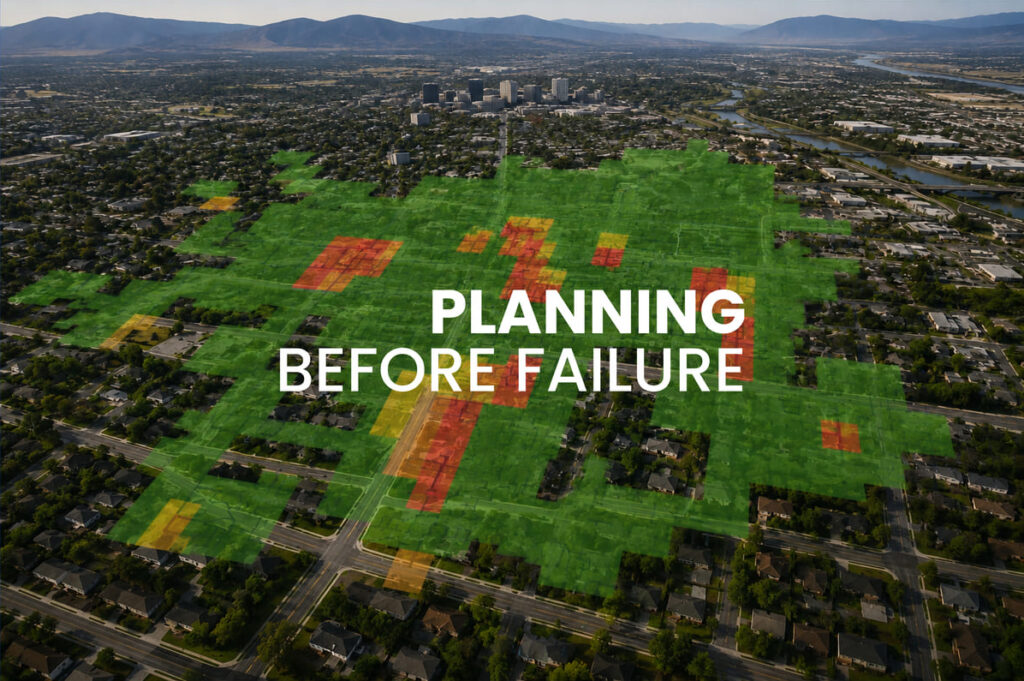
Multiply that scene by roughly 260,000 times a year – the number of water main breaks Utah State University researchers estimate occur annually across the U.S. and Canada, extrapolating a measured break rate of 11.1 failures per 100 miles of pipe across the continent’s roughly 2.33 million miles of water main [2] – and you start to see why water professionals themselves are losing confidence in the system they run.
That’s not rhetorical flourishing. It’s the finding of AWWA’s 2026 State of the Water Industry survey, published in the Journal AWWA. The industry’s five-year outlook has fallen to 4.53 on a 7-point scale, the lowest reading in eight years [1]. In other words, the people closest to the pipes think today is normal and tomorrow will look worse.
An industry showing its age
The numbers behind this pessimism are hard to argue with. The most comprehensive water main break study ever conducted, Utah State University’s 2023 analysis of nearly 400,000 miles of pipe across more than 800 utilities, found an average failure rate of 11.1 breaks per 100 miles of pipe per year, adding up to 260,000 breaks annually and about $2.6 billion in repair costs [2]. Cast iron pipe, much of it installed before World War II, breaks at 28.6 times per 100 miles per year, nearly ten times the rate of modern PVC [2]. The average water main that fails today is 53 years old. Nationally, over one-third of all water mains, 770,000 miles of pipe, have already aged past the half-century mark [2].
The American Society of Civil Engineers’ 2026 Report Card tells the same story from a different angle. The country’s 2 million-plus miles of underground drinking-water pipe serve 90% of the population, much of it installed in the mid-20th century with a design life of 75 to 100 years. A large share of “newer” pipe is already approaching retirement [3]. The average expected life of installed pipes has declined, from 84 years in 2018 to just under 78 today [3]. Utilities lose an estimated 33.3 trillion gallons of treated water annually to leakage, worth more than $187 billion in lost revenue. Nearly 20% of installed water mains, about 452,000 miles, are past their useful life but still in service because there’s no money to replace them [3]. ASCE and the EPA both put the funding gap in stark terms: the EPA’s most recent needs assessment puts the 20-year price tag for U.S. drinking water infrastructure at $625 billion, up 30% from the prior assessment, while ASCE projects the gap between needs and actual investment will nearly double, from $309 billion today to $620 billion by 2043 [3].
McKinsey’s The Infrastructure Moment frames the issue of aging US infrastructure as part of something much larger: it estimates the world will need $106 trillion in infrastructure investment through 2040, with waste and water infrastructure alone requiring roughly $6 trillion, a bill made heavier by the fact that more than two billion people still lack access to safe drinking water globally, and by industrial users like data centers and semiconductor fabs now competing for reliable, ultrapure water supply [4].
The case for predictive intelligence
Faced with aging assets, thin budgets, and a shrinking workforce, the water sector is arriving, cautiously, at the same conclusion other industries reached years ago: you can’t inspect your way out of a 2-million-mile problem, but you might be able to predict your way through it.
The opportunity is concrete, not abstract. The Utah State University pipe study found that break rates vary enormously and predictably by material, diameter, soil corrosivity, and installation era. Cast iron in highly corrosive soil, for instance, fails at rates that dwarf ductile iron in benign soil, and distribution mains, break five times more often than transmission mains [2]. That’s the kind of structured, multivariate pattern that machine learning models are good at learning from. Machine learning can find patterns in complex data with dozens of variables – data too rich and complicated for mere humans to comprehend. It can flag which segments of pipe are most likely to fail next, turning a reactive posture into a prioritized replacement schedule. Industry guidance already calls for a 65/35 split between scheduled and reactive maintenance, and the USU survey found utilities are slowly moving in that direction: their planned-to-reactive ratio has risen from 37% to 42% since 2015. [3]. Predictive models are the mechanism to accelerate that shift.
The tools to do this are already available. The same USU study found that 88.7% of surveyed utilities now use GIS to map their underground assets, and 65% use smart metering. But the picture thins out from there: only 17.5% use real-time system modeling, 15.7% use pressure monitoring, and a mere 6% report using machine learning for condition assessment [2]. That gap, extensive data collection paired with minimal predictive analysis, is a clear opportunity for the industry. Utilities are sitting on the raw material for predictive maintenance without yet having applied an engine to use it. McKinsey’s report makes the same point about infrastructure broadly, describing how AI- and IoT-powered predictive maintenance is already delivering measurable results in adjacent sectors. European rail operators, for example, have cut maintenance costs by roughly 20% and lifted fleet reliability by 15% using predictive diagnostics, and noting that water and waste specifically are being reshaped by AI-powered sorting, route optimization, and condition-monitoring technology [4].
Beyond pipe replacement prioritization, predictive and AI-driven tools have a growing role elsewhere in the water utility: forecasting demand and water stress (a topic AWWA added to its survey for the first time this year); detecting leaks and non-revenue water loss earlier through pressure and acoustic sensor analytics; optimizing chemical dosing and energy use at treatment plants; calibrating or replacing faulty meters; flagging anomalous sensor readings that could indicate a cybersecurity intrusion, a priority for 72% of utilities and a matter 73% of respondents call very important [1]; and modeling where contaminants like PFAS are likely to concentrate so utilities can target monitoring and treatment instead of testing everywhere at once.
Cautious optimism, real gaps
None of this means the water sector is racing to adopt AI. If anything, the AWWA data shows an industry watching from a distance. Fifty-six percent of respondents expect generative AI to have a positive effect on the sector in the coming year, but most expect only incremental gains rather than transformation, a fair description of an industry that treats “mission-critical” as a literal operating principle [1]. The bigger obstacle isn’t skepticism about whether AI works; its governance. Nearly 58% of water professionals cite serious concern about security breaches and deepfakes, and 49% of utilities either have no formal AI policy or one still in development. Only 37% have a framework for ongoing review [1]. Service providers see the same disconnect from the outside: more than 71% rate a technology-savvy workforce as extremely important, yet they describe a persistent gap between how much data they collect and how much anyone is equipped to analyze [1].
That gap is the real story here. The water industry has spent the last decade digitizing, GIS layers, smart meters, SCADA systems, sensor networks, just to keep pace with basic operations. The tools to turn that data into foresight, and the workforce trained to use it, has lagged behind. Closing it doesn’t require a utility to build its own AI team. It requires them to treat predictive modeling the way it already treats corrosion or leak detection: not an experimental add-on, but a standard part of asset management, backed by the same capital planning rigor utilities apply to a new treatment plant or a bond issue.
The moment, not just the money
It’s tempting to see the situation as an old problem: pipes are old, money is short, add another zero. But that undersells what has changed. For the first time, utilities have the data and the modeling tools to decide, block by block, which pipes to replace next, rather than guessing with age alone or break history. McKinsey calls this shift “the infrastructure moment,” arguing that the assets underpinning modern society are being redefined by digital technology as much as by concrete and steel. For water, that moment looks less like a breakthrough and more like closing the gap between the data and the decisions it can inform. Pipes aren’t getting any younger. The question the industry faces isn’t whether it has a problem, every survey agrees it does, but whether it will use the tools now available before the next break decides for them.
This article is part of our AI for Utilities series – where we break down how AI and machine learning can transform water asset management. From risk prediction to proactive prevention, we cut through the hype to share what really works.
 Subscribe to our blog so you don’t miss the next article in the series.
References
1. Roth, Frank. “Declining Confidence: The Water Industry’s Lowest Five-Year Outlook in Eight Years.” *Journal AWWA*, vol. 118, no. 4, May 2026, pp. 46‚Äì52 (State of the Water Industry survey). https://doi.org/10.1002/awwa.70077.
2. Barfuss, Steven L. “Water Main Break Rates in the USA and Canada: A Comprehensive Study.” Utah Water Research Laboratory, Utah State University, December 2023.
3. American Society of Civil Engineers. “2026 Report Card for America’s Infrastructure: Drinking Water.” ASCE, 2026.
4. Green, Alastair, Ishaan Nangia, and Nicola Sandri. “The Infrastructure Moment: Investing in the Expanding Foundations of Modern Society.” McKinsey & Company, September 2025.