It’s the week before the budget workshop. The three-year main replacement plan goes to the board or council, and you already know the questions. Why these pipes? Why not the main that broke last winter? How do you know this is the best use of the budget?
Your team has the data to answer every one. GIS, break history, risk scores, the replacement plan itself. The hard part is getting from the question to the answer fast enough. Which risk metric should lead? Where’s that setting? How do you show a council member the list holds up?
Too often, the answer means days of tedious work. Export the data. Move it between systems. Rebuild the same spreadsheets. Your engineers spend their time on the data, not on the decision.
We built VODA.ai Advisor to change that.
VODA.ai Advisor is the AI water assistant inside VODA.ai. It brings expert guidance to every water asset decision. Ask in plain language. Advisor explains what matters, recommends the next step, and does the work in supported workflows. Here’s how we built it, and why.
The answers exist. Getting to them is the hard part.
Every utility is running the same math. The EPA estimates that U.S. drinking water systems need $625 billion in infrastructure investment over the next 20 years. Capital needs keep growing. Teams stay the same size. And every dollar in the capital improvement plan has to be explained to people who don’t read risk models for a living.
The team isn’t the problem. Utility engineers know their systems. They know which neighborhoods break every winter and which mains keep them up at night. What slows them down is everything around the decision: pulling data from different systems, juggling spreadsheets, finding the right metric, checking the result. Work that should take minutes takes days.
They don’t need another tool to learn. They need the busywork off their plate.
“Questions that used to take days of juggling spreadsheets now start with a conversation. That frees engineers for the part that needs their judgment.”
Why we didn’t bolt a chatbot onto VODA.ai
General AI tools are good at general questions. They don’t know your system, your workflows, or how utility engineers approach risk. Ask one how to prioritize pipe replacement, and you get an answer that could apply to any utility in the country.
For utilities, a fast answer is not enough. It has to be the right answer, grounded in water practice and your own data. And it has to lead to the next step in the software.
AI built for this work has to understand likelihood of failure (LOF), consequence of failure (COF), and business risk exposure (BRE). It has to work with your network data and know the software your team uses every day. And it has to be clear about what it can and can’t do.
So we didn’t put a chat window next to the software. We built Advisor into it.
How does VODA.ai Advisor work?
VODA.ai Advisor is conversational AI for water utilities. Five things shape every answer.
Water industry knowledge. Advisor is built on water industry knowledge and the VODA.ai knowledge base. It answers the way a senior engineer would: what matters, why, and what to do next.
Your data. Ask about your own system in plain language, and Advisor goes straight to the metrics and breakdowns you need. Every number comes from your data, never estimated by AI.
Knowledge of the software. Advisor knows how VODA.ai works. In supported workflows, it takes you to the right screen, applies settings, and enters your inputs.
Context on your screen. Advisor sees what you see, so you don’t have to explain where you are.
Internet search. When a question needs current or outside information, Advisor searches the internet.
We set two rules early. Advisor is transparent: if a request is outside what it supports, it says so instead of guessing. And it only uses data you already have permission to access.
Then we tested it against more than 270 real utility tasks and scenarios, from risk profiling to replacement planning, with answers reviewed by water engineers. So when your engineers act on its answers, they can stand behind them.
What can you ask VODA.ai Advisor?
The questions teams ask most fall into four groups. Here’s what each looks like in practice.
1. Concepts: “What does this metric actually tell me?”
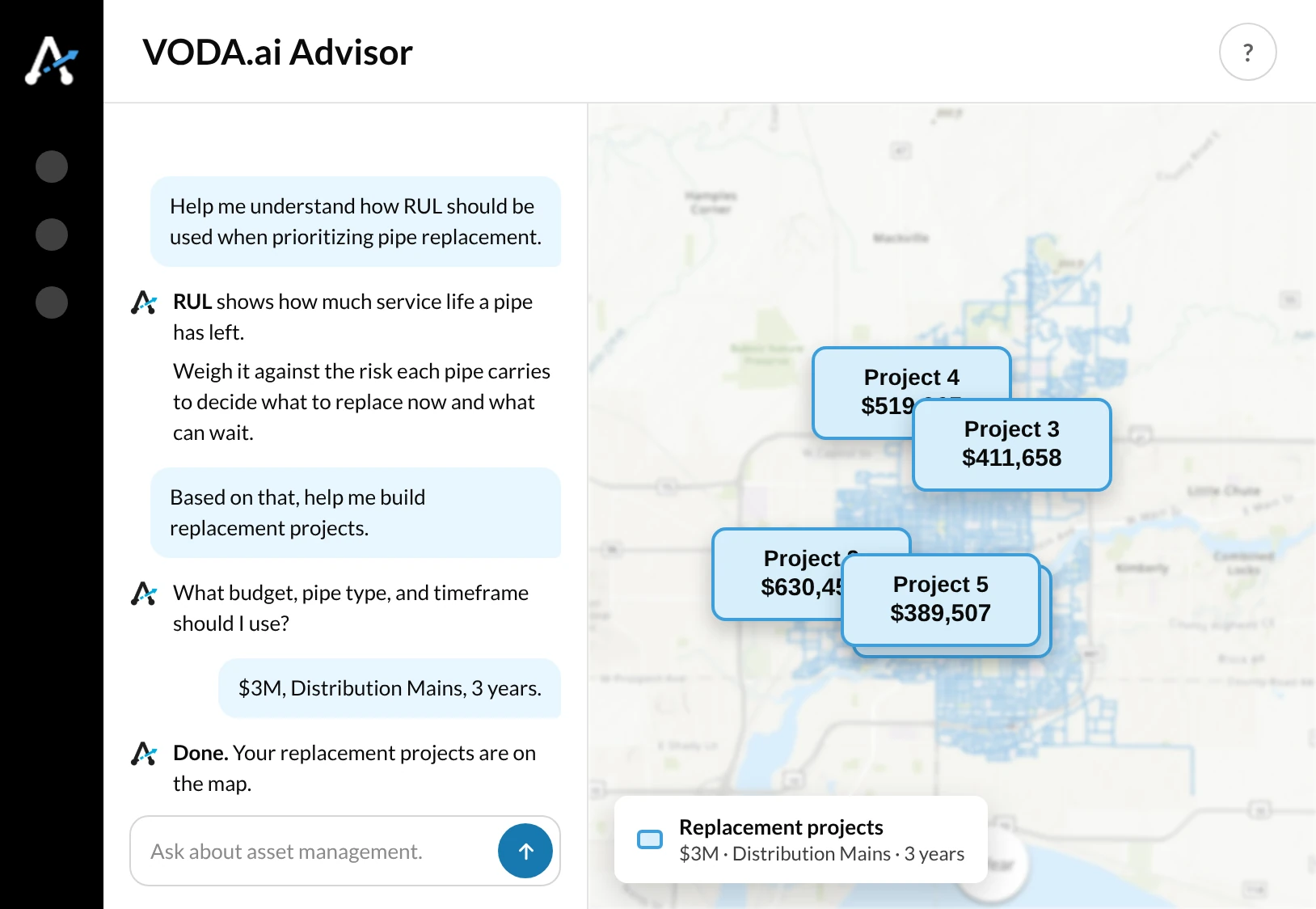
An engineer has to defend a ranking. A director has to present the plan to the board. Both need to understand the metrics behind it and explain them in plain words. Ask, “Help me understand how RUL should be used when prioritizing pipe replacement.” Advisor explains what remaining useful life (RUL) shows, how to weigh it against each pipe’s risk, and what to replace now versus later.
2. Your network data: “How much cast iron do we have?”
These numbers come up in every capital conversation, and they usually mean a GIS request or a spreadsheet export. Ask for the total length of cast iron mains, or pipes by install year, and Advisor answers from your own data. You get the figure in the conversation, ready for the plan, the presentation, or the board memo.
3. A single pipe: “Why is this main on the list?”
Every engineer gets this question from a council member, a manager, or a resident. Click the pipe and ask. Advisor explains the risk behind it, such as why it ranks in the top 1%. You know why the pipe matters before you act, and you can explain it to anyone who asks.
4. Help with a task: “Build the projects for me.”
This is where Advisor moves from answering to doing. Ask, “Help me build replacement projects,” and it does the setup with you, step by step. Here’s how that plays out.
Back to the budget workshop
You need the three-year plan by Friday. With Advisor, it looks like this.
- Ask. “Help me build replacement projects.”
- Answer a few questions. Advisor asks for the budget, pipe type, and timeframe, the same inputs you’d give your consultant.
- Get projects. Advisor fills in the replacement dialog and returns the projects on the map.
- Check the results. Ask, “How do I check these are the best projects?” Advisor suggests ways to validate them, such as heat map overlays and pipe-level queries.
- Decide. Your team reviews the projects and makes the call.
No spreadsheet juggling. No support ticket. One conversation, from question to a plan you can take into the workshop. Capital planning is just one example. Advisor works the same way across every VODA.ai workflow: pipe risk management, replacement planning, condition assessment, logger placement, meters, and lead service lines.
Decision support, not autopilot
Water infrastructure decisions carry real consequences. So we were clear from the start about who decides.
Utility decisions have to hold up in front of a board, a council, or a regulator. Engineers can defend a decision they understand and made themselves. So Advisor explains, recommends, and does the setup work. The engineer makes the call.
Your experts stay in charge. Advisor gives them better tools for high-impact, high-consequence decisions. Less time moving data between systems. More time on the questions only they can answer.
“The utilities that lead the next decade will put their experts’ time into decisions, not data wrangling. VODA.ai Advisor brings domain knowledge, the utility’s own data, and the planning power of the software together for the decisions that matter most. It doesn’t replace the engineer. It makes the job better.”
See our AI assistant for water utilities in action, or read how VODA.ai turns your data into decisions.